How AI Employees Help Home Service Businesses Price the Job and Keep the Margin Honest

Caption: A business owner works through job paperwork at home. Description: The scene shows how price details can end up scattered across paper, phone notes, and old cost information.
It is Tuesday night. The owner is at his kitchen table at 8:40 with three things in front of him: a photo of a furnace data plate on his phone, a voice memo of himself measuring a duct run that morning, and a supplier receipt from a job he finished two weeks ago.
He is building the same estimate he has built a hundred times before, from scratch, on a sheet of paper folded and unfolded so often the crease has worn through. The homeowner texted at six asking what the damage is. He will finish around eleven. The price he types will come from a price sheet he last updated in the spring, using what he remembers copper and refrigerant cost then.
The receipt is the other half of the problem. On that finished job, somebody approved extra work on a handshake in a driveway. It never became a change order. It never made it onto the invoice.
He is not a bad businessman. He is a busy one, holding four versions of the same price in four different places.
That is the paperwork problem. A price starts in the price book, turns into estimate options, may change in the field, and ends up on an invoice. If those versions do not stay connected to the right costs and approvals, the margin can quietly slip away.
Why does one price keep coming out four different ways?
A price in a home service business lives in more places than anyone wants to admit. It starts as a rule in a price book. It becomes a line-item estimate with options. It changes in a driveway. It ends up on an invoice. When four versions of one number get built by different people on different days, they drift apart. Not because anyone is careless. Because nothing ties them together.
| When every version of the price lives on its own | When every version traces back to an approval |
|---|---|
| The estimate gets rebuilt from scratch at the kitchen table | The estimate starts from the price-book item and the job notes |
| Good-better-best is three numbers with unclear differences | Each option carries its own scope, exclusions and price |
| A field change lives in a text message | The change becomes a written change order before the work |
| The invoice is the first place a missing line shows up | The invoice gets checked against approved scope before it goes out |
| The owner learns at tax time which jobs made money | The look-back shows which price-book items need attention |
The rest of this article walks that second column, one step at a time.
An estimate without a version number is a rumor.
What does it take to keep one price connected from start to finish?
For a home service business with a few trucks, pricing often moves between the owner, office staff, technicians, paper forms, and software. An AI employee can help keep those pieces aligned. Think of it as a paperwork steward: it organizes details and carries approved changes forward, while people remain responsible for decisions.
The central rule is simple: every version of the price should have a source, a status, and a link to the customer’s approval.
How do you build a price book you can explain?
The price book is the starting point for repeatable work. It should spell out the service, what is included, labor assumptions, material assumptions, and how the selling price is set. If costs, labor rates, or markups change, that update should be reviewed and recorded before it flows into new estimates.
An AI employee can help compare job notes with the right price-book items, flag missing or stale cost information, and prepare line items for review. It should show where a proposed price came from, not quietly fill in a gap with a guess.
The owner still sets the pricing rules. A person should review unfamiliar work, unusual site conditions, discounts, and exceptions. A furnace data plate or duct measurement can support an estimate, but it does not tell the whole story about access, hidden damage, or the work a customer will approve.
If you are still working out which jobs belong to an AI employee and which stay with a person, this step-by-step guide to building an AI workforce is a sensible place to start. For the plain-English version of the idea itself, read what is an AI employee.
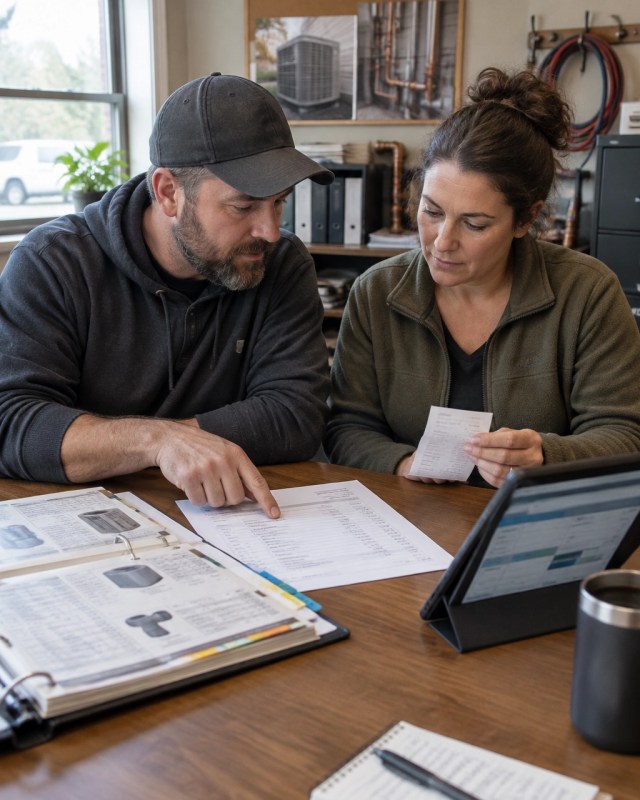
Caption: A business owner and office manager check an estimate together. Description: The price book and estimate should use the same current service details and pricing rules.
How do you make every version of an estimate traceable?
An estimate should identify the job, date, scope, and price-book version behind it. If the owner changes a line, the updated version should show what changed and who approved it. That matters whether the estimate is a furnace repair, a landscaping plan, a custom cabinet order, or electrical work.
Good-better-best options can help customers compare clear choices. They should represent real differences in scope, materials, or service, not just three prices for work that is hard to distinguish. Each option needs its own line items, exclusions, and price. The customer’s selection should be saved with the exact estimate version they accepted.
An AI employee can draft options from approved services and flag a missing description or cost input. It should not decide what the customer needs, invent a premium option, or choose a discount. Clear beats clever. Customers and crews should be able to tell what each option includes.
This is not only a heating and cooling problem. An electrician deciding whether a panel upgrade is one line item or four, a roofer pricing a tear-off that turns out to have two layers of shingles instead of one, a landscaper quoting a retaining wall that needed a drainage bed nobody mentioned, a painter whose square footage changed because the furniture stayed in the room, and a small cabinet shop pricing a custom island all face the same thing. A price built on assumptions only holds if the assumptions are written down next to it.
What does a field change look like when the paperwork keeps up?
Extra work often starts with a reasonable conversation: a technician finds a problem, explains it to the homeowner, and agrees on a change. The paperwork fails when that decision stays in a text, a voice memo, or someone’s memory.
A consistent change-order process should capture:
- The original estimate or job it changes.
- What is being added, removed, or replaced.
- The price difference and any schedule impact.
- Who approved the change, and when.
- The exact version the customer accepted.
A price the customer never saw is not a price. It is a surprise.
An AI employee can turn a technician’s notes into a change-order draft, attach related job details, and check that required fields are present. It can then route the draft for review. But the business owner or authorized employee should confirm the scope and price, and the customer should approve the final version before non-emergency extra work begins.
If the scope or price changes after approval, create a new version and request approval again. Do not edit the signed version in place. That keeps the original agreement clear and prevents a later invoice from pointing to a price the customer never saw.

Caption: A technician discusses a written change with a homeowner. Description: The form should show the added work and price before the crew proceeds.
How do you know the invoice matches what the customer approved?
The final invoice is another version of the job’s price. It should reflect the accepted estimate and any approved changes, not simply the first quote or a handwritten total from the field.
An AI employee can help compare the completed job’s line items with the estimate and approved change orders. It can flag possible mismatches, such as work that appears on the invoice but not in an approved change, or an approved change that is missing from the final amount. A person should resolve the exception before the invoice goes out.
This is not about turning the invoice into a bookkeeping task. It is about checking that the amount charged matches the work and price the customer approved.
What does the job look-back actually tell you?
A price can look profitable on paper and still miss the mark once the real labor and material costs are known. After a job closes, compare the estimate with actual costs. Separate direct job costs from overhead, and use your own accounting definitions consistently. Gross margin and markup are not the same: margin measures what remains from the selling price after direct costs; markup measures how much is added to cost.
A simple margin check is:
Gross margin = (selling price − direct job costs) ÷ selling price
That calculation does not replace your full pricing model. It gives you a consistent way to review what happened on a job. Look for repeated gaps: a service priced with old material costs, labor assumptions that no longer fit, or extra work that was completed but not approved and billed.

Caption: A business owner reviews a finished job’s estimate and cost notes. Description: A regular look-back helps reveal where the estimated price differed from the work performed.
An AI employee can line up the estimate, approved changes, and actual job costs, then explain where they differ. It can flag a possible margin issue for review. The owner decides what the number means and what to change next. A single job may be unusual; patterns across similar jobs are more useful for deciding whether to update a price-book item.
One job is a story. Five jobs are data.
What does an AI employee actually do with all this?
The AI employee is not the estimator. It is the one who stops the paperwork from asking the same questions twice. In a normal week the work looks like this:
- Gather what the job already has: a photo of a data plate, a voice memo of a measurement, a supplier receipt, a text from a tech in a driveway, and the notes from the last similar job.
- Draft the estimate from approved price-book items, and flag what is missing instead of guessing at it.
- Build the options with their own scope, exclusions and price, ready for the owner to check.
- Turn field notes into a change-order draft showing the added work, the price difference, and who said yes.
- Compare the invoice with the accepted estimate and every approved change before it goes out.
- Line up the closed job against its actual costs and show where the two parted ways.
- Watch for repeats. If the same price-book item keeps coming in low, put the last several jobs that touched it in front of the owner.
None of that is estimating. It is the handling around the estimate: the copying, the chasing, the comparing, the remembering. That is the part that eats an owner’s evenings. If you want to see what one of these looks like in practice, Marblism’s AI employees are built for exactly this kind of back-office handling.
There is a staff-facing cousin to this idea worth reading next: how AI employees give your construction team one place to find every answer.
What should stay a human decision?
AI can organize information, draft line items, compare versions, and surface inconsistencies. It can also miss context, misread a note, or rely on outdated inputs. Keep a person responsible for:
- Setting labor rates, material markups, and discount limits.
- Approving unusual scope, pricing exceptions, and customer commitments.
- Confirming that a change order is accepted before work proceeds.
- Reviewing invoice differences and job-margin alerts.
- Updating the price book when the business has evidence to support a change.
The best first step is modest: choose one common job type and compare its price-book entry, estimates, changes, invoices, and final job costs. Note where versions stop matching. Then decide which checks an AI employee may prepare and which decisions must stay with a person.
At Aimee’s Marketing, AI helps create blog drafts, organize research, improve marketing campaigns, and assist with customer communication. Rather than replacing people, AI allows us to spend more time serving clients and developing new ideas. The same principle applies to price paperwork: automate the repetitive checks so people can focus on judgment, customer relationships, and good work. For more on that balance, read AI vs. human employees: which is better for your small business?. If the phone and the quotes that go quiet are also costing you hours, here is how AI employees help local service businesses answer every call, quote and follow up. And if written bids and project schedules are the bigger bottleneck, this is how construction businesses keep bids and projects on track.
What does the crew actually get back?
Not a number. A set of small changes that add up.
The owner gets part of his Tuesday night back, because the estimate starts from a price-book item instead of a blank sheet.
The technician stops re-explaining a driveway conversation from memory, because the change was written down before he packed up.
The office manager can answer “what did we charge for that?” in a few seconds, because that job’s versions sit in one place.
The customer gets an invoice that matches the estimate they signed, which is a quieter kind of trust than a good review.
And the price book gets updated when the evidence shows up, instead of in a panic every spring.
What can an owner do this week?
- Pick the five jobs you price most often and write each one as a price-book entry: what is included, what is not, your labor assumption, your material assumption, and where the current cost came from.
- Of those five, pick the three that hurt most when they are wrong, the ones where a missed line or an unbilled change costs real money.
- For those three, look back at two or three finished jobs and check whether the estimate, the changes and the invoice tell the same story.
- Give every change order a written form, even a simple one: what changed, what it costs, who approved it, and when.
- Choose one person, or one AI employee, whose job is keeping those versions lined up. Not deciding the price. Keeping the paperwork honest.
If you are still deciding what an AI employee could reasonably carry for a small team, start here before you change anything about how you price.
Simplified Summary
What is this article about?
It explains how an AI employee can help keep a job’s price consistent from the price book to the estimate, change order, and final invoice.
Why should I care?
When those records do not match, extra work can go unbilled and job costs can be easy to miss.
How do I do it?
Start with one common job. Connect its pricing, approved changes, invoice, and final costs. Let AI organize and compare the details, but have a person approve prices and changes.
What is the main goal?
Make sure every price has a clear source and approval, so the business can see what each job really earned.
Take the next step: Pick one recent job and check whether its estimate, the changes, the invoice, and the costs tell the same story. If they do not, that gap is the first thing to hand over. To see how AI employees could hold that paperwork for your crew, learn about Marblism AI employees. If you help other businesses put AI to work, apply here to become a partner.
These are affiliate links. Business PR News may earn a commission if you use them.


